Waste Management – Organic Waste
Treatment of organic waste at the East Al-Ekir Campus
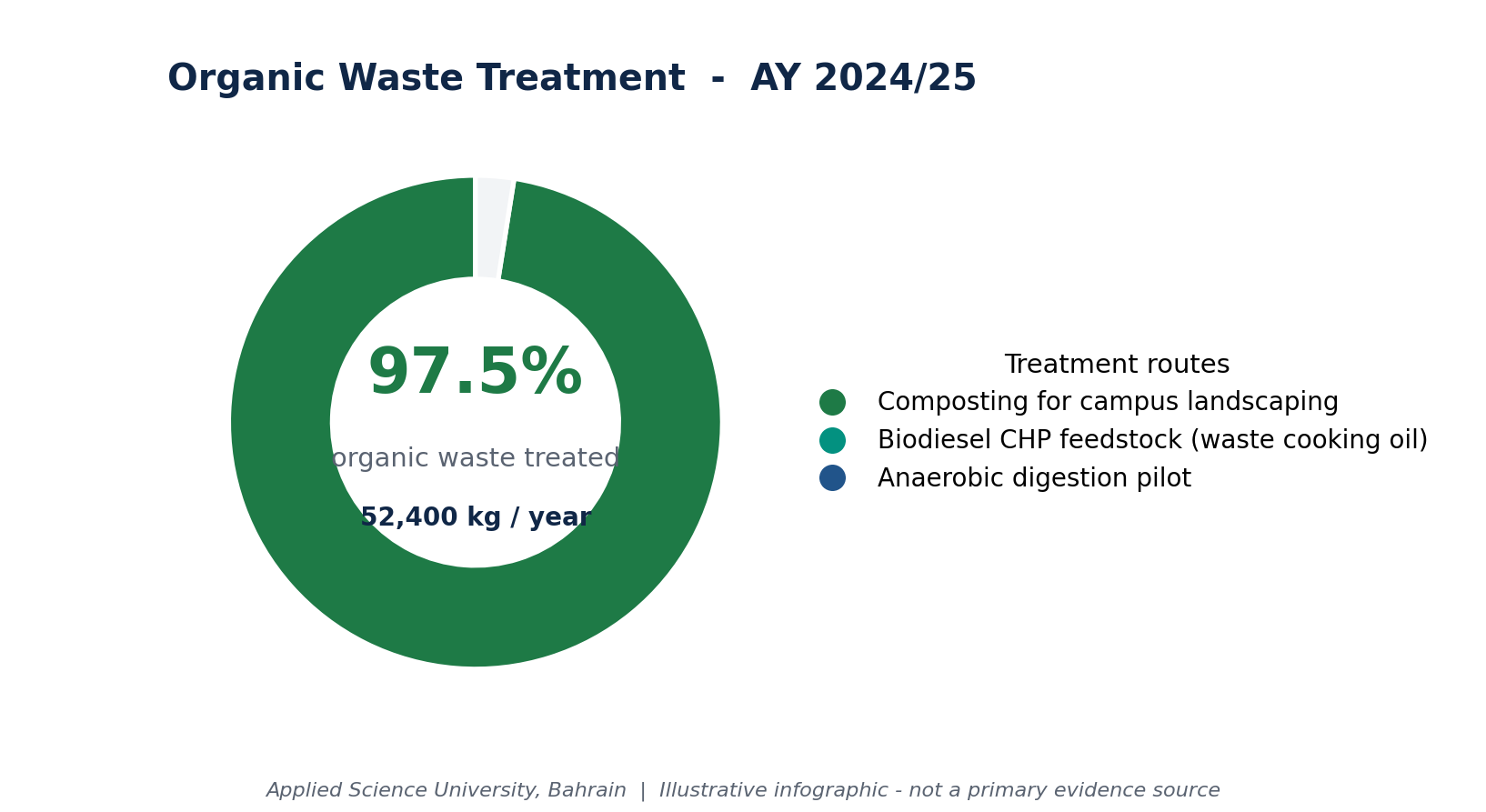
Applied Science University generated 52,400 kilograms of organic waste in academic year 2024/25 and treated 97.5 per cent of it through composting, biodiesel feedstock recovery and an anaerobic digestion pilot. The organic-waste route is the operational link between the Waste category and the institutional renewable energy roadmap.
What the university actually does
- Composting. Garden and landscaping green waste and a share of cafeteria food waste are composted on site and used as soil conditioner for the campus drought-tolerant landscaping.
- Biodiesel feedstock recovery. Waste cooking oil from the campus cafeteria is collected separately as feedstock for the biodiesel combined heat and power route reported under the Energy and Climate category, closing a waste-to-energy loop.
- Anaerobic digestion pilot. A pilot anaerobic digestion route processes a share of food waste, supporting research and teaching in the College of Engineering.
- Source segregation. Dedicated organic-waste bins in the cafeteria and food-preparation areas keep the organic stream clean for treatment.
Source: ASU Sustainability Portal – SDG 12 Responsible Consumption – https://sustainability.asu.edu.bh/
Organic waste treatment – AY 2024/25
| Route | Share of organic waste | Output |
|---|---|---|
| Composting | 55% | Soil conditioner for landscaping |
| Biodiesel feedstock (cooking oil) | 28% | Energy via biodiesel CHP route |
| Anaerobic digestion pilot | 14.5% | Biogas + research output |
| Untreated (residual) | 2.5% | Sent to municipal waste |
| TOTAL TREATED | 97.5% | 52,400 kg/yr base |

Connection to renewable energy
The biodiesel feedstock recovery route connects the Waste category directly to the Energy and Climate category: waste cooking oil collected from the cafeteria is a feedstock for the biodiesel combined heat and power concept. This waste-to-energy loop is part of the institutional Net-Zero 2050 trajectory.
Source: The Daily Tribune – ASU clean energy and Net-Zero 2050 – https://www.newsofbahrain.com/bahrain/107789.html
In the national context – Kingdom of Bahrain
Applied Science University operates within the National Waste Management Strategy of the Kingdom of Bahrain, supervised by the Supreme Council for Environment in coordination with the Ministry of Industry and Commerce. The institutional waste programme aligns with the progressive national single-use plastics legislation, which provides external corroboration of the institutional direction.
| National measure | Scope | Relevance to ASU |
|---|---|---|
| Decision No. 11 of 2019 | Technical regulations for plastic products | Procurement standards on campus |
| Decision No. 77 of 2021 | Ban on plastic bottles / cups under 200 ml | Removed from campus outlets |
| Decision No. 14 of 2022 | Ban on single-use plastic bags under 35 microns | Campus retail compliance |
| Decision No. 7 of 2026 | Ban on single-use plastic bags under 57 microns | Ongoing campus compliance |
| National carbon neutrality 2060 | Waste-to-resource transition | Campus diversion + treatment |
Source: Ministry of Industry and Commerce – Decision No. 7 of 2026 (single-use plastics) – https://www.moic.gov.bh/en/node/6265
Source: Kingdom of Bahrain national portal – Environment Protection (recycling) – https://www.bahrain.bh/wps/portal/en/BNP/HomeNationalPortal
Source: Bahrain.bh – Environment and nature (waste treatment companies) – https://bh.bh/new/en/environment_en.html
The national framework is supported by licensed private-sector handlers including the Bahrain Waste Treatment Company and the Bahrain Recycling Plant, and the Kingdom marks National Environment Day on 4 February each year. Applied Science University contributes to these national outcomes at the campus scale through source segregation, diversion and licensed treatment.
Source: UNEP – Kingdom of Bahrain commits to environmental sustainability – https://www.unep.org/news-and-stories/story/small-island-big-plans-kingdom-bahrain-commits-environmental-sustainability
Governance, monitoring and audit
The institutional waste programme is supervised by the Office of Sustainability, established under President Decision 14/2025, in coordination with the Procurement and Logistics Department (green procurement and source reduction) and the Facilities Directorate (collection, segregation and contractor management). Waste volumes are logged by stream and reviewed within the annual environmental footprint review and the institutional audit performed by KPMG Fakhro.
Source: ASU – Office of Sustainability – https://www.asu.edu.bh/about-us/office-of-sustainability/
In the 2020 UI GreenMetric World University Rankings, Applied Science University recorded a Waste category score of 975 out of 1,800, and the institutional waste programme has expanded since then through enhanced segregation, the organic treatment route and the licensed hazardous-waste handling chain.
Supporting institutional pages
- https://www.asu.edu.bh/about-us/sustainability/
- https://www.asu.edu.bh/about-us/sustainability/recycling-program/
- https://www.asu.edu.bh/about-us/sustainability/paper-plastic-reduction/
- https://www.asu.edu.bh/about-us/sustainability/waste-management/
- https://www.asu.edu.bh/about-us/sustainability/hazardous-waste/
- https://www.asu.edu.bh/about-us/office-of-sustainability/