Paper and Plastic Reduction
Reducing paper and plastic waste at the East Al-Ekir Campus
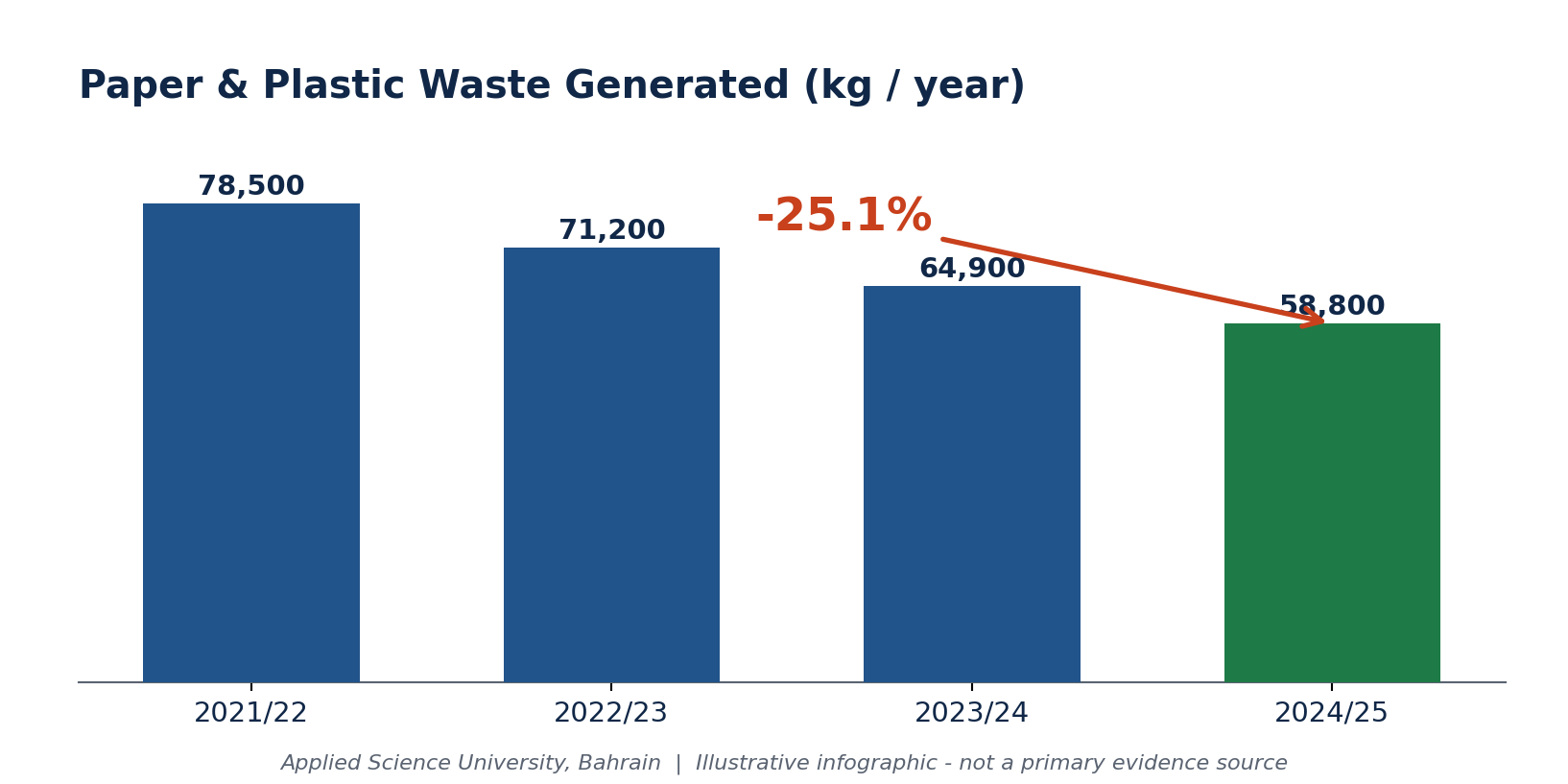
Applied Science University generated 58,800 kilograms of paper and plastic waste in academic year 2024/25, a reduction of 25.1 per cent over the three-year window, driven by digital-first administration, green procurement and the removal of single-use plastics from campus outlets in line with national legislation.
What the university actually does
- Digital-first administration. Learning management systems, electronic forms, digital assessment and electronic document workflows reduce printing across academic and administrative processes.
- Default duplex printing. Printers default to double-sided printing, and print-management quotas discourage unnecessary printing.
- Recycled and FSC paper. The Procurement and Logistics Department procures 100 per cent recycled or FSC-certified paper, closing the loop on paper consumption.
- Single-use plastic removal. Plastic water bottles and cups under 200 ml and thin single-use plastic bags have been removed from campus outlets, with refill stations and reusable alternatives provided.
- Source segregation. Dedicated paper and plastic recycling bins across campus feed the licensed off-site recycling chain.
Source: ASU Sustainability Portal – SDG 12 (green procurement, recycled paper) – https://sustainability.asu.edu.bh/
Reduction trajectory
| Academic year | Paper & plastic (kg) | Change |
|---|---|---|
| 2021/22 (baseline) | 78,500 | – |
| 2022/23 | 71,200 | -9.3% |
| 2023/24 | 64,900 | -17.3% cumulative |
| 2024/25 | 58,800 | -25.1% cumulative |

In the national context – Kingdom of Bahrain
Applied Science University operates within the National Waste Management Strategy of the Kingdom of Bahrain, supervised by the Supreme Council for Environment in coordination with the Ministry of Industry and Commerce. The institutional waste programme aligns with the progressive national single-use plastics legislation, which provides external corroboration of the institutional direction.
| National measure | Scope | Relevance to ASU |
|---|---|---|
| Decision No. 11 of 2019 | Technical regulations for plastic products | Procurement standards on campus |
| Decision No. 77 of 2021 | Ban on plastic bottles / cups under 200 ml | Removed from campus outlets |
| Decision No. 14 of 2022 | Ban on single-use plastic bags under 35 microns | Campus retail compliance |
| Decision No. 7 of 2026 | Ban on single-use plastic bags under 57 microns | Ongoing campus compliance |
| National carbon neutrality 2060 | Waste-to-resource transition | Campus diversion + treatment |
Source: Ministry of Industry and Commerce – Decision No. 7 of 2026 (single-use plastics) – https://www.moic.gov.bh/en/node/6265
Source: Kingdom of Bahrain national portal – Environment Protection (recycling) – https://www.bahrain.bh/wps/portal/en/BNP/HomeNationalPortal
Source: Bahrain.bh – Environment and nature (waste treatment companies) – https://bh.bh/new/en/environment_en.html
The national framework is supported by licensed private-sector handlers including the Bahrain Waste Treatment Company and the Bahrain Recycling Plant, and the Kingdom marks National Environment Day on 4 February each year. Applied Science University contributes to these national outcomes at the campus scale through source segregation, diversion and licensed treatment.
Source: UNEP – Kingdom of Bahrain commits to environmental sustainability – https://www.unep.org/news-and-stories/story/small-island-big-plans-kingdom-bahrain-commits-environmental-sustainability
Governance, monitoring and audit
The institutional waste programme is supervised by the Office of Sustainability, established under President Decision 14/2025, in coordination with the Procurement and Logistics Department (green procurement and source reduction) and the Facilities Directorate (collection, segregation and contractor management). Waste volumes are logged by stream and reviewed within the annual environmental footprint review and the institutional audit performed by KPMG Fakhro.
Source: ASU – Office of Sustainability – https://www.asu.edu.bh/about-us/office-of-sustainability/
In the 2020 UI GreenMetric World University Rankings, Applied Science University recorded a Waste category score of 975 out of 1,800, and the institutional waste programme has expanded since then through enhanced segregation, the organic treatment route and the licensed hazardous-waste handling chain.
Supporting institutional pages
- https://www.asu.edu.bh/about-us/sustainability/
- https://www.asu.edu.bh/about-us/sustainability/recycling-program/
- https://www.asu.edu.bh/about-us/sustainability/paper-plastic-reduction/
- https://www.asu.edu.bh/about-us/sustainability/waste-management/
- https://www.asu.edu.bh/about-us/sustainability/hazardous-waste/
- https://www.asu.edu.bh/about-us/office-of-sustainability/